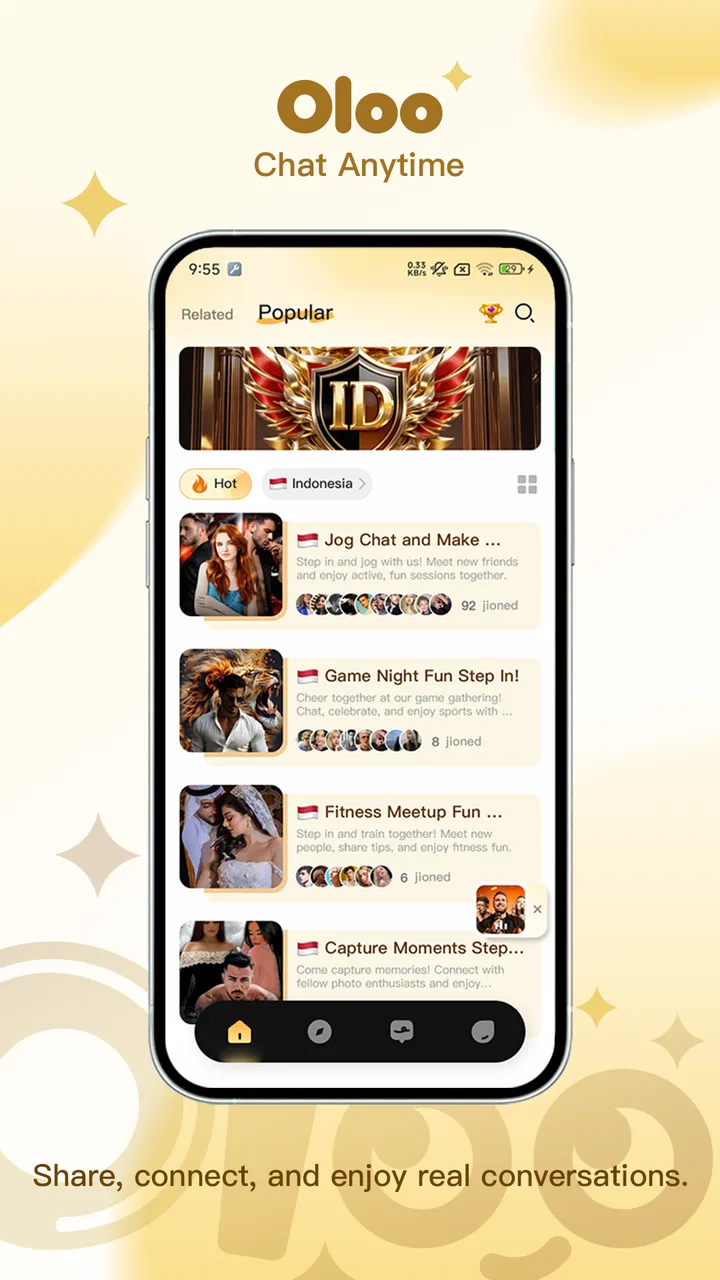
Oloo - Your Group, Your Vibe
- 0.0
- Rating
- 10.00K
- Installs
- Free
- Price

 Analysis by App-foxy
I approached Oloo as a social events app rather than as another general-purpose chat tool. Its basic idea is easy to understand: people can talk, join groups built around interests, and share activities they find enjoyable. That combination can be useful when you want conversation tied to something specific, such as a hobby, a local plan, or a recurring interest, instead of an endless stream of unrelated posts.
My first impression is that Oloo is aimed at users who want a more focused social space. It is free to install, and Infinite Joy Studio presents it for a Teen audience. The app belongs in the events category, but its experience seems to sit between group communication and activity discovery. That distinction matters. I would not treat it as a replacement for a dedicated calendar, a private messenger, or a large established social network. I would use it when the social connection and the activity are meant to support each other.
How Oloo fits into everyday social planning
The most practical way to understand Oloo is to imagine a small decision that is otherwise difficult to organize. Suppose I want to find people interested in an evening photography walk, a casual gaming session, or a weekend discussion about a favorite subject. A normal messenger can handle the conversation once everyone is already connected, while a calendar can record the time and place. Neither one is especially good at helping the right people discover the idea in the first place. Oloo’s group-oriented approach is designed for that middle step.
You May Also Like

 AccuWeather: Weather Radar
AccuWeather Review: A Quick, Clear Forecast for Everyday Decisions
For everyday plans, the best forecast is the one you can understand quickly. AccuWeather makes rain timing, radar, and local conditions easy to act on, with a few trade-offs.

 Hill Climb Racing
Why Hill Climb Racing Still Turns Crashes Into One More Run
A tiny car, a bumpy hill and one more upgrade: Hill Climb Racing keeps resurfacing because its simple chaos makes every near-miss feel personal.

 AliExpress - Shopping App
AliExpress Makes Global Shopping Feel Personal, but Shoppers Bear the Risk
AliExpress turns a global marketplace into a pocket-sized discovery engine. Its reach is useful, its shopping loop compelling, and its trade-offs easy to miss.

 Lords Mobile: Kingdom Wars
Lords Mobile Is a Kingdom-Building Routine, Not a Quick Match
A case-by-case verdict on the building, battles, device demands, and social commitments that make Lords Mobile rewarding for some players and exhausting for others.

 PDF Scanner app - TapScanner
TapScanner Makes Paperwork Easier to Capture, Check, and Share
TapScanner makes scanning with a phone feel less like a rescue operation and more like a dependable step in getting work done. Its capture tools are useful, though not flawless.

 Block Blast!
 Shows How Much a Puzzle Game Can Leave Out
A quiet grid game shows why puzzle players increasingly value instant clarity, repeatable skill and low-pressure play—and where the genre still needs to catch up.
More From Our News Desk
View All News


In that situation, I would begin with an interest group instead of sending individual invitations. I could explain the activity, see whether the idea attracts the right audience, and continue the conversation in one shared place. This reduces the awkwardness of guessing who might be interested. It also creates a clearer boundary between a group built around one activity and a personal contact list that gradually becomes difficult to manage.
That workflow is more valuable for informal plans than for formal events. If I were organizing a paid conference, a large appointment schedule, or an event requiring tickets and attendance records, I would choose a specialized events service. Oloo makes more sense for lightweight participation: people exchanging ideas, finding common interests, and turning conversation into something they can do together.
The app is also a reasonable option for someone who feels that broad social feeds are too noisy. A focused group can give a conversation a purpose, although the quality will still depend on who joins and how actively they participate. Oloo cannot manufacture a lively community by itself. Its usefulness rises when there is a clear shared interest and falls when a group has no direction.
What I would use it for first
I would start with one specific interest rather than joining many groups at once. That is a small but important habit. A narrow group makes it easier to understand why the conversation exists, what kind of posts belong there, and whether the people involved are actually interested in meeting or sharing activities. Joining too broadly can turn a focused social tool into another stream that demands attention.
A realistic example would be a student who wants to arrange a study break with people who enjoy the same music or games. Instead of mixing the plan into a large personal chat, the student could use an interest-based group to test the idea, collect suggestions, and decide whether the activity is worth arranging. I like this use because the group has a natural reason to exist, and participants can choose their level of involvement without every message becoming a direct interruption.
Another useful scenario is a newcomer looking for a social entry point. Joining a group around a genuine interest can feel less forced than approaching a general community with no clear topic. The trade-off is that users should still take normal care when interacting with people they do not know. A shared interest is a starting point, not proof that someone is trustworthy.
Trust begins with what the app lets me see
Because Oloo combines communication, groups, and shared activities, I would pay close attention to the choices shown during account creation and normal use. I want to know what information is requested, which details are visible to other participants, and whether I can change those choices later. Those are more meaningful trust signals than a polished interface or a short slogan.
I would also read each permission request in context rather than accepting everything automatically. If a feature needs access to something on my device, I would ask whether that access is necessary for the action I am trying to perform. A social app should not receive more access than I am comfortable granting simply because I want to test one group. If a permission can be denied while keeping the main experience usable, I would prefer that route.
My cautious approach is especially important because group conversations can encourage people to reveal more than they intended. A casual introduction may include a name, location, school, workplace, schedule, or other personal detail. Before posting, I would consider whether that information is needed for the activity. In many cases, it is enough to say what I enjoy and what kind of event I would like to join.
The safest Oloo experience is one where I choose the audience and the amount of personal detail deliberately. I would avoid treating an interest group as a private room unless the app clearly shows that it is private and explains who can participate. Public visibility, group membership, and direct conversation are different levels of exposure, and I would check those distinctions before sharing anything sensitive.
Account controls deserve a careful first look
When I try a new community app, I do not wait for a problem before looking for account controls. I check whether the app gives me a clear way to manage my profile, leave a group, adjust visibility, and handle unwanted interactions. These actions are part of the basic user experience, not optional extras. If they are difficult to find, I become less comfortable using the service for personal conversations.
For Oloo, I would make a short setup routine. First, I would use the smallest profile description that still helps people understand my interests. Next, I would inspect the group options before posting. Then I would look for ways to mute, leave, or report a conversation if it becomes uncomfortable. Finally, I would review any account or privacy area again after joining a few groups, because the practical choices can become clearer once the app has real content.
This routine also answers an important question for cautious users: can I participate without making my whole identity available? The answer depends on the choices Oloo presents in the app, so I would not assume that a nickname or limited profile automatically provides anonymity. I would use only the information I am comfortable showing to other participants and would reassess that decision before joining activity-based groups with unfamiliar people.
If I were setting up the app for a teenager, I would discuss these controls together rather than simply handing over the device. The Teen content rating is useful context, but it does not replace personal judgment. A young user should know how to exit a group, stop responding, and ask for help if a conversation becomes pressuring or inappropriate. The same advice applies to adults, since social pressure can affect anyone.
Data-sensitive moments happen during ordinary sharing
The riskiest moments in an app like Oloo are not necessarily dramatic. They can happen during a normal invitation or a friendly introduction. Posting a meeting place may reveal a routine. Sharing a photo can expose a school, home, or workplace in the background. Mentioning that nobody will be home can create a safety issue. I would keep activity details general until I know the group and the participants better.
I would also separate planning information from personal contact information. If a group discussion can handle the arrangement, there is no reason to immediately publish a phone number, personal email address, or exact home address. A public meeting location is generally easier to manage than a private one, and I would prefer an activity where leaving is simple if the group dynamic feels wrong.
There is a useful trade-off here. More detail can make an activity easier to coordinate, but it also increases exposure. I would share the time and broad area first, confirm that the plan is genuine, and provide more specific information only when it is necessary and appropriate. This staged approach is one of the most practical ways to keep control while still using a social events app for its intended purpose.
Photos and shared activities deserve the same care. Before posting an image, I would check whether it includes other people who have not agreed to appear, visible documents, location clues, or identifying details in the background. Before joining an activity, I would consider whether I understand who is organizing it and what participation involves. Oloo can help people connect around an idea, but it cannot remove the responsibility of deciding whether that idea is safe.
Where it differs from familiar alternatives
Compared with a standard messenger, Oloo’s appeal is discovery through shared interests. A messenger is usually strongest when I already know the people involved and need fast, direct coordination. Oloo is more suitable when the group itself is part of the discovery process. The disadvantage is that an open or unfamiliar group may require more patience and more careful boundaries than a conversation with trusted contacts.
Compared with a broad social network, Oloo appears more purpose-driven. A large network can offer greater reach, established communities, and a constant flow of content, but that reach often brings noise. Oloo may feel calmer when the group topic is specific. On the other hand, a smaller service may offer fewer active communities for unusual interests, so a user may need to try several groups before finding one with meaningful participation.
Compared with a dedicated event platform, Oloo is likely to be more conversational and informal. A specialized platform is preferable when I need registration, ticketing, attendance management, detailed schedules, or formal organizer tools. Oloo is the better fit when the activity grows naturally from a conversation and the participants value interaction as much as logistics.
That comparison also explains who should skip it. If I only need private messaging, I would stay with a messenger. If I need a professional event workflow, I would choose a purpose-built service. If I dislike meeting unfamiliar people online or do not want to manage group boundaries, Oloo may create more work than value. Its strength is not universal convenience; it is the connection between interests, conversation, and casual participation.
What the current release means for a new user
Oloo is free to install, which makes it easy to try without committing money at the beginning. The app includes optional purchases ranging from $0.99 to $99.99 per item, so I would pay attention to purchase prompts and make sure I understand what I am buying before confirming anything. A free starting point is helpful, but it should not be confused with every part of the experience being cost-free.
The app was released on October 28, 2025, and the current version is 1.1.8. I would keep it updated through the normal app store process, especially because early versions of community apps can change quickly as the developer improves account handling, group behavior, and reporting flows. Infinite Joy Studio is the developer behind it, and the relatively early stage makes it sensible to approach the service with curiosity rather than assuming it already has the maturity of a long-established network.
Its minimum operating requirement is Android 7.0. That makes the compatibility barrier fairly approachable for users with older Android devices, although the quality of the experience will still depend on the phone, connection, and the activity level of the communities I join. I would not judge the app solely by whether it installs successfully; responsiveness, notification behavior, and the usefulness of available groups matter more once I begin using it.
The displayed average rating is 0.0, while the app has passed the ten-thousand-install mark. I would interpret that combination cautiously rather than drawing a strong conclusion from it. It tells me that people have installed the app, but it does not give me a dependable picture of satisfaction. I would spend time testing the controls, group quality, and conversation experience for myself before making Oloo part of my routine.
Small habits that make the experience better
My first practical tip is to create a clear purpose for every group I join. If I cannot explain what the group is for in one sentence, I probably do not need it yet. This keeps notifications manageable and makes it easier to notice when a conversation drifts away from the original interest.
My second tip is to avoid publishing a complete plan in one message. I would separate the idea, the general timing, and the final meeting details. That makes changes easier and reduces the amount of sensitive information sitting in a single post. It is also useful when several people are still deciding whether they want to participate.
My third tip is to test the exit path before I need it. I would find the options for leaving a group, muting activity, or handling unwanted contact while the experience is still comfortable. Knowing where those controls are reduces hesitation later. If I cannot locate them easily, I would treat that as a reason to limit my participation and avoid sharing personal details.
A fourth habit is to keep purchases separate from social pressure. An activity can feel more valuable when other people are enthusiastic, but that does not mean I should buy an optional item immediately. I would review the price, purpose, and confirmation screen calmly, particularly because the purchase range reaches from small amounts to substantially larger ones.
My cautious recommendation
I see Oloo as a promising option for people who want social interaction organized around interests and enjoyable activities rather than an unrestricted feed. I like the possibility of moving from “I am interested in this” to “let us do something about it” without forcing every plan into a private contact list. The format can be especially useful for casual communities, new friendships, and low-pressure group ideas.
My recommendation comes with clear conditions. I would use a limited profile, review every visible account choice, share activity details gradually, and avoid assuming that a group is private unless the app says so clearly. I would also keep expectations realistic: the value of Oloo depends heavily on finding active, respectful groups, and the current rating gives me no strong reason to assume that every community will be equally polished.
For someone who wants to experiment with interest-based groups and is comfortable managing privacy carefully, Oloo is worth trying because it is free to start. For someone seeking a mature event-management system, a private family messenger, or a platform with an established reputation, another category of app would be a better choice. I would keep Oloo in the “try thoughtfully” category: useful when its social purpose matches your needs, but best approached with deliberate controls and modest expectations.
FAQs for Oloo - Your Group, Your Vibe
01What is Oloo and what can I use it for?
Oloo is a social networking app designed to help users connect with groups based on shared interests and vibes. Whether you're looking to join a book club, a hiking group, or a music band, Oloo provides a platform to discover and interact with like-minded individuals. It's perfect for building communities and fostering new friendships.
02Is Oloo available for both Android and iOS devices?
Yes, Oloo is available for download on both Android and iOS platforms. You can find it on the Google Play Store for Android devices and the Apple App Store for iOS devices. Ensure your device meets the minimum operating system requirements to enjoy a smooth user experience.
03How does Oloo ensure my privacy and data security?
Oloo prioritizes user privacy and data security by implementing robust encryption protocols and privacy settings. You have control over who sees your profile and activities. Furthermore, Oloo does not share your personal information with third parties without your consent, ensuring a safe environment for social interactions.
04Are there any in-app purchases or subscriptions in Oloo?
Oloo offers a free version with essential features, but there are also premium options available. These in-app purchases or subscriptions can unlock additional features such as advanced group management tools, ad-free experiences, and exclusive content. This provides users with flexibility depending on their preferences and needs.
05Can I create my own group on Oloo?
Yes, Oloo allows users to create their own groups easily. You can set up a group based on any interest or activity, invite friends, and manage membership settings. This feature is perfect for those who wish to start a community or gather people with similar interests in one place.
Pros
- User-friendly interface for easy navigation.
- Efficient group organization tools.
- Customizable group settings.
- Seamless integration with social media.
- Real-time notifications keep you updated.
Cons
- Limited theme customization options.
- Occasional app crashes reported.
- Requires stable internet connection.
- Some features locked behind a paywall.
- Limited language support available.

Oloo - Your Group, Your Vibe
Gallery